

After pounds and pounds of bean pressure cooking I got it right. Here is your fail-proof guide for Instant Pot Beans. Instant Pot black beans, Instant Pot pinto beans, instant pot kidney beans, and many more, basically an encyclopedia about cooking beans in the instant pot.
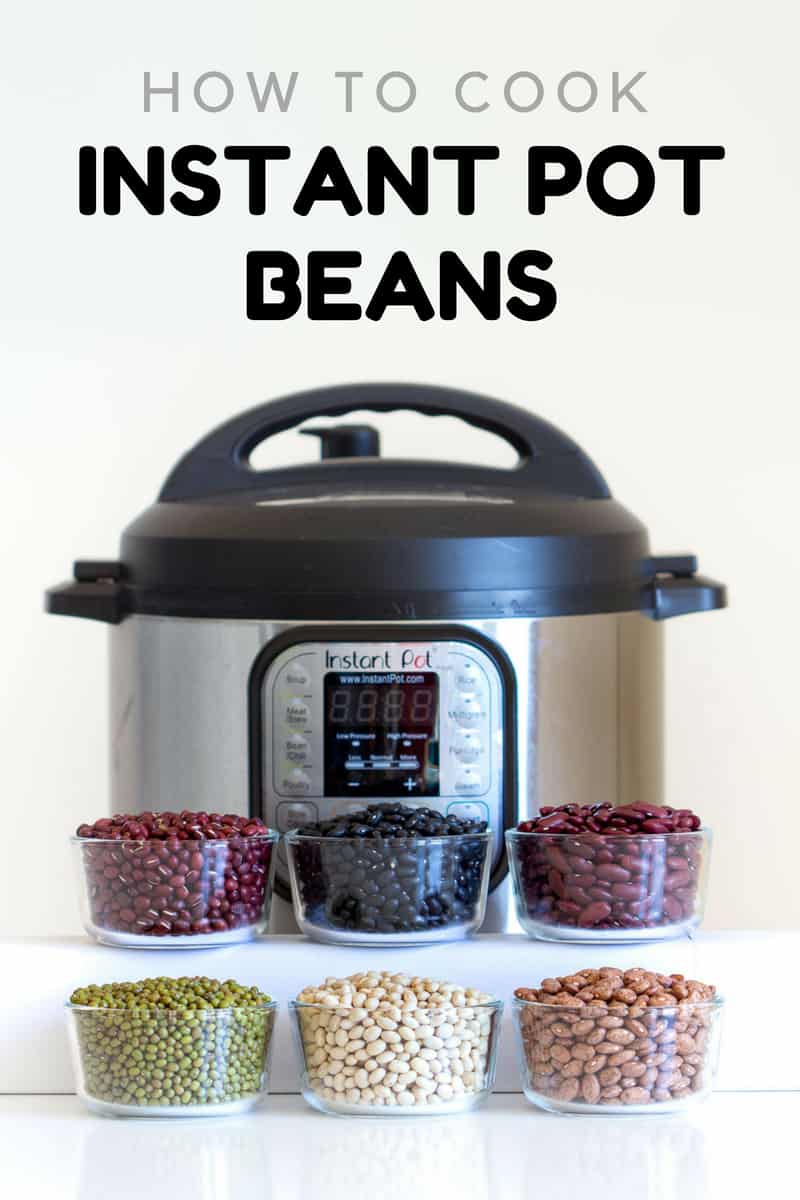
After seeing the same question popping up over and over again in several Facebook groups: “how to cook beans in the instant pot”, and after reading answers that couldn’t differ any more, I felt the urge to find out timings for myself. Just like back when I saw the same happening for Instant Pot Rice.
I’ve read people recommending cook times anywhere from 10 minutes all the way up to 60 minutes. How can that be? Why do the recommended times differ SO MUCH?!? I had to get to the bottom of it.
Well, first of all, many times it isn’t even specified what kind of beans. There are soooooo many kinds and they all cook in different times. Asking “how to cook beans in the instant pot” is basically an incomplete question and often results in incomplete answers.
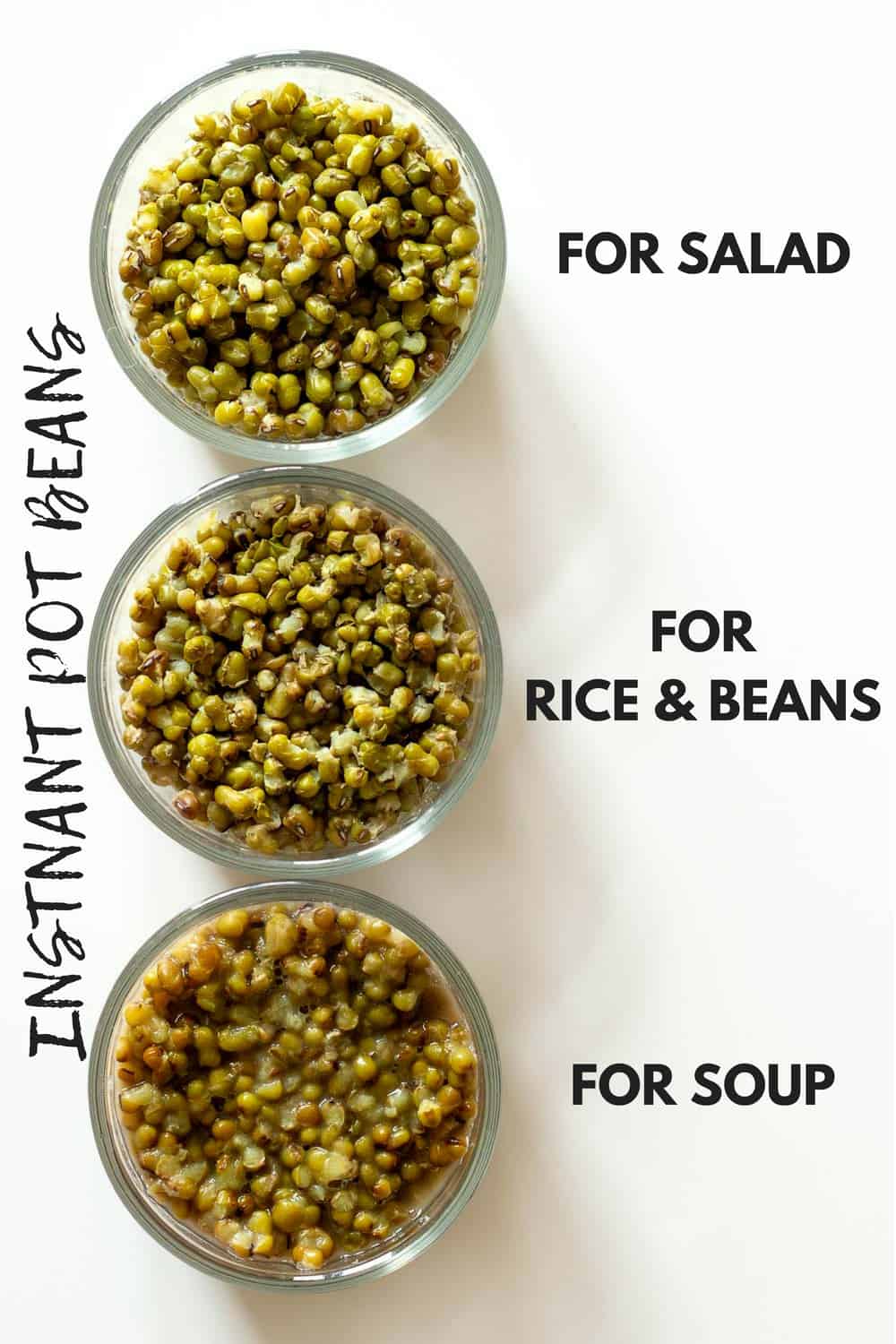
Second of all, it is never specified what the beans are meant for. Depending on if you want them for a salad or a soup makes a huge difference. For a salad you want them barely cooked so they hold their shape, stay dry and don’t become mushy. For a soup you want them super cooked and falling apart by themselves so you can blend them and create a creamy soup.
And lastly,it is rarely specified if the cooking time is requested or suggested for soaked or dry beans. This also plays a huge role in timing.
Which brings us to the first question and answer in our Instant Pot Beans Encyclopedia.
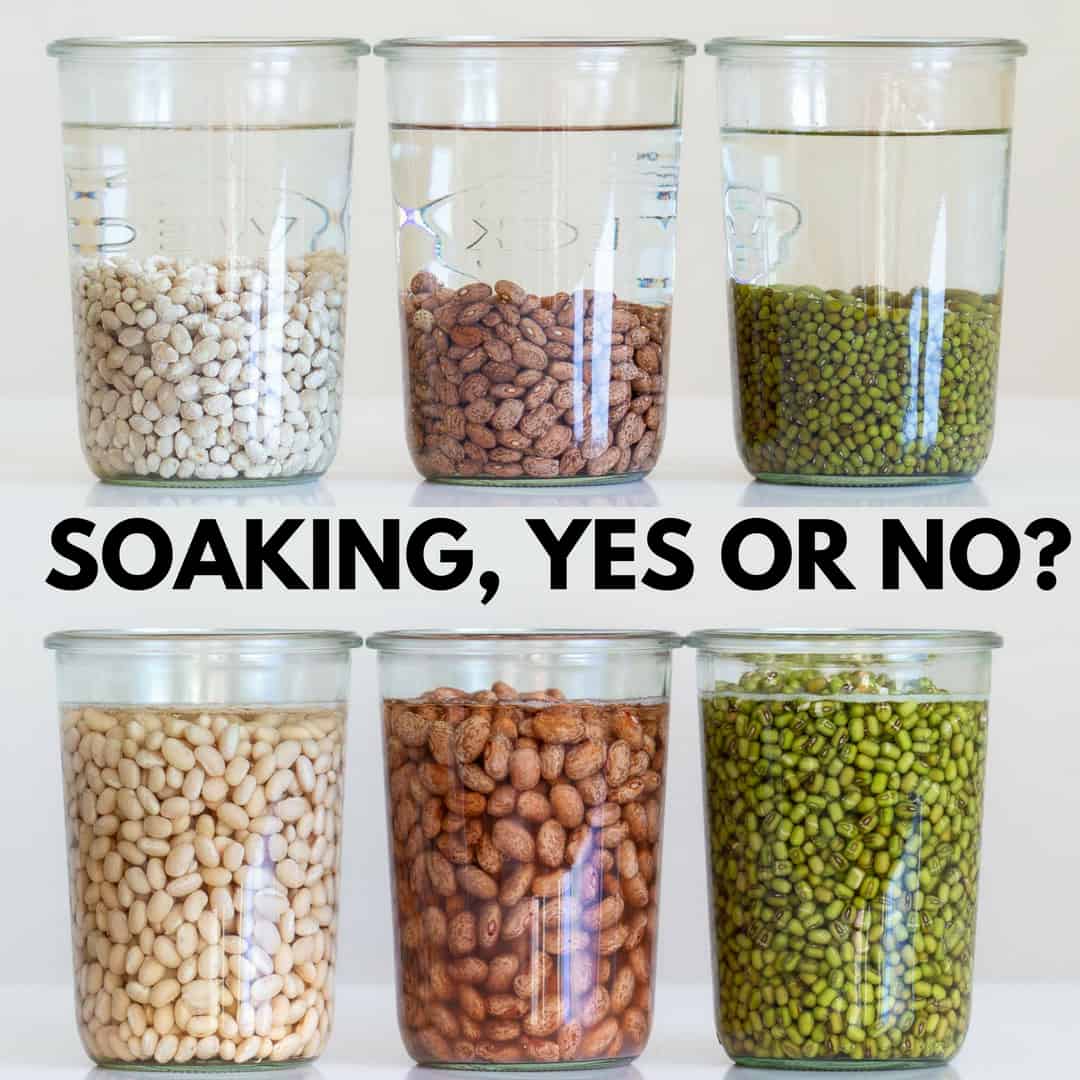
Soaking or No Soaking for Instant Pot Beans
Let me answer one important thing first: yes, you CAN cook both, soaked and unsoaked beans in the pressure cooker. So if you desperately want to skip the soaking process you absolutely CAN.
The question, however, should not be if you CAN cook no soak beans. The question is: do you really want to skip the step?
I never (literally never!) skip soaking. Why? Because it eases digestion A LOT. I, for one, don’t love feeling bloated and passing wind. If you enjoy that, by all means, go ahead and skip the step ;)
If you’re more like me and like eating healthy and yummy food without bloating and farting (high five my friend) then soak your beans for 8-12 hours before pressure cooking.
Generations and generations before us already knew about this trick and I rely a lot on their experience. A pressure cooker doesn’t break down the beans to a point where soaking isn’t necessary anymore to ease digestion. Maybe one day someone will invent a magical machine that can but for now, there isn’t one on the market that I know.
What the instant pot does it cook beans faster to reach the same consistency a regular pot with water does. That’s the advantage of pressure cooking. The soaking is still necessary.
There are other tricks to ease digestion such as adding “epazote” during the cooking process and/or removing the foam that forms on top. The most important and most effective is soaking though. Don’t skip the soaking even if you add epazote and remove the foam.
Sooooo, all experiments run for this post are for beans soaked for 12 hours at room temperature using filtered water. Then drained and rinsed and cooked in just plain, fresh, unsalted water.
Ok, now that we’ve had have that discussion let’s get to the next point.
Instant Pot Black Beans
My fist tests were run with Black Beans and that’s how I found out that the discrepancies of timing are often times likely due to what the beans are meant for.
After cooking for 30 minutes + complete natural pressure release the beans were nice and soft and perfect to use for a soup. They were cooked to the necessary consistency to blend into a smooth black bean soup.
However, they were way too soft to drain and use for a salad. They were much much softer than the black beans you’d find in a can for example.
The canned black beans are pretty firm and after draining ideal for a salad for example.
So the next goal was to find the best pressure cook timing to achieve firm beans for salad AND a consistency somewhere in between for Instant Pot Beans and Rice. Not too firm and not too soft.
After 20 minutes of high pressure cooking and full natural pressure release the Instant Pot Black Beans were thoroghly cooked through but still firm. I was able to drain them and use them in a salad.
After 25 minutes they had that perfect consistency for Instant Pot Beans and Rice.
Instant Pot Pinto Beans
I thought all beans the same size would cook in the same time but no. It seems different beans have a different composition and cook differently.
Pinto Beans cooked faster in my experiment compared to black beans. I was very surprised actually. So much so, that I will have to rerun this experiment. Pinto Beans were the last beans I experimented with and I’m wondering if my Instant Pots (<– yes, plural, I have several because I’m obsessed, haha) were maybe overheating and cooking stuff faster?
Anyway, the Adzuki Beans definitely confirmed the fact that different beans cook at different times regardless of size.
The Instant Pot Pinto Beans were perfect for draining and using in salads after just 15 minutes high pressure and full natural pressure release.
Perfect for rice and beans after 20 minutes high pressure cooking + NPR. And suitable for soups after 25 minutes HP + NPR.
Flavoring Instant Pot Beans (salt while or after cooking)
Depending on what you want your Instant Pot Beans for you may or may not want to flavor them.
If you want your beans for a salad which will have a salad dressing it’s probably best to simply cook them in filtered water and nothing else. Drain the water and use the unflavored beans for your salad.
For Instant Pot Beans and Rice or for soup you’ll probably want to flavor while cooking. There is a couple simple rules to follow. Add onion, garlic, spices (except salt) before or during cooking but salt after cooking. Salt can keep beans from softening up so you want to avoid adding while they are cooking but rather once they’re already soft.
What I love to do is to prepare a “sofrita” first. You hit the sautée button first and while the pot heats you peel and finely chop onion and garlic. Once hot, add a splash of oil, the chopped onion and garlic and sauté until nice and brown. Then add beans and water and cook as instructed in the recipe card below.
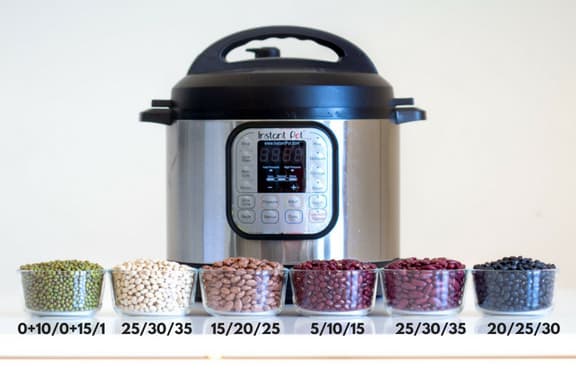
And here the printable fool-proof timing guide for Instant Pot Beans:
Instant Pot Beans
Ingredients
- 1-3 cups beans - (black beans, pinto beans, adzuki beans, kidney beans, navy beans, or mung beans)
- water
Instructions
- Add beans to a large bowl and cover with abundant filtered water. At least 4 times as much water as beans. Cover with a clean dish towel. Soak for 8-12 hours on the kitchen counter. (If you soak them longer timings will differ!)
- Drain beans and rinse really really well.
- Add beans to instant pot and cover with fresh water to about 2 inches above the beans (two thumbs thick).
- Put on the lid and turn the knob to the sealing position.
- Press manual (or pressure cook on newer models) set to high pressure and adjust timing follows depending on if you need the beans for salad/rice and beans/soup:Black Beans: 20/25/30 minutes + 20 mins NPRPinto Beans: 15/20/25 + 20 mins NPRNavy Beans: 25/30/35 + 20 mins NPRKidney Beans: 25/30/35 + 20 mins NPRAdzuki Beans: 5/10/15 + 20 mins NPRMung Beans: 0 + 10 min NPR / 0 + 15 min NPR / 1 + 20 mins NPR
- Let pressure release naturally for specified time above, then, if safety pin hasn't dropped on its own yet, release remaining pressure manually.
 Tropical Overnight Chia Pudding
 Authentic Salsa Verde
 Instant Pot Steel Cut Oats + 12 Topping Ideas
Marissa Ze says
Thanks for the informative post! I’m planning to cook navy beans. I’m not sure I understand the cooking time correctly – your post says Navy Beans: 25/30/35 + full NPR.
Does this mean pre-soaked navy beans need to be cooked for about 30 minutes? It seems a bit too much. The instant pot site lists 7-8 minutes for pre-soaked navy beans…
Lorena says
Hi Marissa, depending on what your want your beans for (a salad, a side, or a soup) I listed cooking times for different consistencies. In my opinion 12-hour pre-soaked navy beans need at the very least 25 minutes of high pressure cooking + natural pressure release. I’ve tested all kinds of times and maybe my Instant Pots were overheating after the 10th batch and not working properly but I doubt they can be properly cooked in 7-8 minutes.
Dan says
Wow great write up! I’ve noticed all these discrepancies between different websites too and have thought “my how incomplete these questions and answers are!” One thing I didn’t see you talk about though was at what altitude these cook times are for? I’ve recently lived in CO and had to adjust all my IP times. I assume these are sea level times but you never know….!
Lorena says
Hi Dan, yes I live at sea level so they are all sea level times. From what I’ve read you have to add 5% cooking time per every 1,000 feet of altitude. I will never be able to confirm exact cooking times for anything but sea level because that’s where I do all experiments and cooking, but you’re right I will have to be more specific about this in future posts. Thank you for pointing it out :)
Jahnvi says
Hi,
This is very helpful! Thank you for running this experiment. (:
The mung bean times are a tad confusing. When you say 0 + 10 minutes NPR for salad, do you mean allow the pressure to build and then just hit cancel and allow it to drop for 10 minutes?
Or allow pressure to build to full, cook at it for 1 minute and then a full pressure drop for soup?
Thanks!
Jahnvi says
Scrolled down and found your responses to others who have asked this. No worries!
Lorena says
:)
Teri says
I m new to instapot —my question. I have large Lima beans. I will soak them -but then do I follow Manuel time for navy or white beans?
Lorena says
Hey Teri, ugh, sorry I haven’t tried cooking those myself yet but I would try the navy beans times.
Ann says
I’m a volunteer for @culturesgroup. I’m also a retired food microbiologist.
We cook a lot of beans on a daily basis. Sometimes the best way to do so is using an Instant Pot (pots, actually), especially if we’re making a large batch of bean based koji to make something like soy sauce or miso or a sweetener using only the sugars available in grains or legumes or potatoes .
I was so pleased to see that you stressed soaking the beans for at least 12 hours.
If you don’t pre-soak (we use tepid water and change water several times during soaking to remove potential toxins – especially with soybeans, but not exclusively – and start the process of removing those things in the beans you really should remove! I love you stressed that you took the advice of people that had most likely doing this for decades and decades. For centuries, without microscopes or even knowledge of the yeasts, fungus and bacteria that all healthy foods are composed of, they knew they had to somehow do something to prevent illness while enhancing taste and digestibility.
The ability of humans to metabolize or digest legumes (beans), and also at the same time extract nutrients is also dramatically decreased if you don not pre-soak the beans! The nutritional value is greatly diminished. As you mentioned, the things that typically cause gas and digestive difficulties cannot be pressure cooked away.
Although another volunteer had forgotten to soak azuki beans for a preparation we are making, after searching around for some justification to do so – I knew there wasn’t but the sirens of convenience! – I soaked the beans after reading your approach. The smell of the soaking water alone reminded me I had done the right thing. Not pretty! Rice soaked beans very well, indeed!
I then pressured cooked the azuki beans for 5 minutes and let them naturally depressurize, then added some them in Instant Pots and collected the aquafaba (leftover bean cooking water) for the many things we use that for. So I’m really glad I came upon your site. Oh, and it’s sofrito or soffritto but never ending in an A. Sorry, it’s data accuracy thing.
I’m going to check out your rice thing now!
Ann
Lorena says
Ann, thank you so much for your wonderfully thoughtful and educational comment!! I love it!
Cristina says
Great guide and so needed! Thanks!
Tonya says
This is an incredibly helpful IP bean cooking guide!! Where would beans for hummus fit in this guide? Are they closest to “salad beans” or “beans and rice”?
Lorena says
I’m so happy it’s useful to you Tonya :) Chickpeas I usually cook 20 minutes on high pressure and complete natural pressure release. I want to do another post about chickpeas and lentils and maybe dried peas. I’ll see if I can get the testing done this fall.
Judi Rana says
Yes! Please chickpeas and lentils!
Dan says
Yes I’d love to see this testing results too! And if you ever get around to it: grains and pseudo grains (like buckwheat and quinoa) would be nice too.
Lorena says
Hey Dan, I’ll work on it :) I already have a post about how to cook Quinoa in the Instant Pot. Just use the search bar of my blog and enter “Instant Pot Quinoa”.
Nancy says
Do you presoak the chickpeas also?
Lorena says
Hi Nancy, I soak ALL my legumes (beans, chickpeas, lentils) for 12+ hours. I can’t digest them properly if they haven’t been soaked.
Donna says
Thank you so much Lorena for “doing ALL the work” on getting beans right. Appreciate your blog & sharing on your trials & suggesses so we can just soak, cook, & enjoy.
Lorena says
You are very welcome Donna :) Thank you for appreciating my work.
Linda says
Great article, looking forward to utilizing your research.
Question .. have you researched ways to CAN beans so they are like what we buy at the store? First, and only, attempt at canning beans completely annihilated them! More importantly, I have to learn how to can Cream of Mushroom & Cream of Chicken soups (was diagnosed celiac, no wheat, etc). Have you been successful in this? There are polar opposite opinions on canning with or without the cream. Would love to hear if you have a success story on this as I really need to accomplish this.
Lorena says
Hi Linda, I don’t have experience with canning or preserving in general. Beans I freeze and that works well. I freeze them in 1.5-2 cup portions in reusable air-tight sealable silicone bags. For canning and preserving in general I HIGHLY recommend the cookbook “Batch” from Dana Harrison and Joel MacCharles. I have it at home and I absolutely love it. ALL the info you will ever need about preserving.
Vicki says
So, you use the manual button instead of the Bean/Chili button? Have you ever used the Bean/Chili button and had different results?
Lorena says
I only use the manual button because it’s the only one that gives me the option to choose time and pressure. For rice for example the button is completely useless I find. It only serves for white rice, no other rice and it doesn’t cook as nicely as I cook setting everything manually.
Adrian @ Breezy Brain says
I usually cook soaked beans in an uncovered pot and it takes 1-2 hours (depending on which type). Never used a pressure cooker for beans but I’m impressed by how much time (and money) it can save. Will sure remember these tips the next time I cook beans.
Lorena says
I’m happy your find my guide useful Adrian :) Any soaking is better than no soaking. 8-12 hours is my favorite.
Kate says
Your IP “recipe” for short grain brown rice worked really well. Will soak kidney beans overnight and try your bean recipe in the morning. Thank you!
Lorena says
I’m so happy you liked it Kate! Thank you for stopping by and commenting :)
Janice says
What does the 0+10, 0+15, 1+ mean (mung beans) ?
Lorena says
0 minutes on high pressure + 10 minutes natural pressure release. It’s all explained in the blog post Janice.
Vicki says
I reread the blog post 3 times and don’t see the explanation about the mung beans. (0 minutes on high pressure + 10 minutes NPR). Can you please explain here, thank you.
Lorena says
Hey Vicky, 0 minutes on high pressure + 10 minutes NPR simply means that you set your Instant Pot to Manual > High Pressure and then set the time to 0 minutes. Which means the pot will get all the way to high pressure and immediately stop heating and turn to keep warm function. You leave it like that for 10 minutes without touching and then you release the remaining pressure until the pin drops, open and enjoy.
Lisa says
Thanks — hate it when beans for salads are mushy! How long does the NPR take? Seems different for me each time and I suspect I wait too long…
Lorena says
There is no rhyme or reason to it. No matter what I cook, no matter what amount and no matter if it’s the same amount of the same thing, NPR is ALWAYS different. After 20 minutes it’s defo save to just turn the valve and let the last bit of steam off manually if there is any in there at all. Sometimes the safety pin is just stuck and by turning the valve you notice no pressure in there anymore. It’s save to shake the lid a little so the pin drops and you can open.
M says
I’ve done several experiments regarding adding salt vs not adding salt to the bean cooking process and have found the salt myth to be well, a myth. Beans taste better with salt! Soaked and salted is the way for me! Thanks for such a good blog post!
Lorena says
You are very welcome! I’ve tested it, too and noticed a slight difference. Nothing major. It’s mostly following the Mexican grandmas advice because she’s grandma, lol
Carolyn Tanner says
I agree. I’ve never had salt prevent my beans from cooking.
Lorena says
It definitely doesn’t “prevent” them from cooking. If you prefer adding ahead of time, just do it! Just don’t tell grandma :P
Jennifer says
This is the post I’ve been looking for! Thank you so much! I have a pot of black beans on now (soaked of course!), and a second pot of white beans waiting. Going to bag and freeze them for quick simple meals!
Lorena says
I’m so happy you found my post useful Jennifer!!! :D